I was looking up the meaning of “galoot” – an old-fashioned slang word for a clumsy, foolish person.
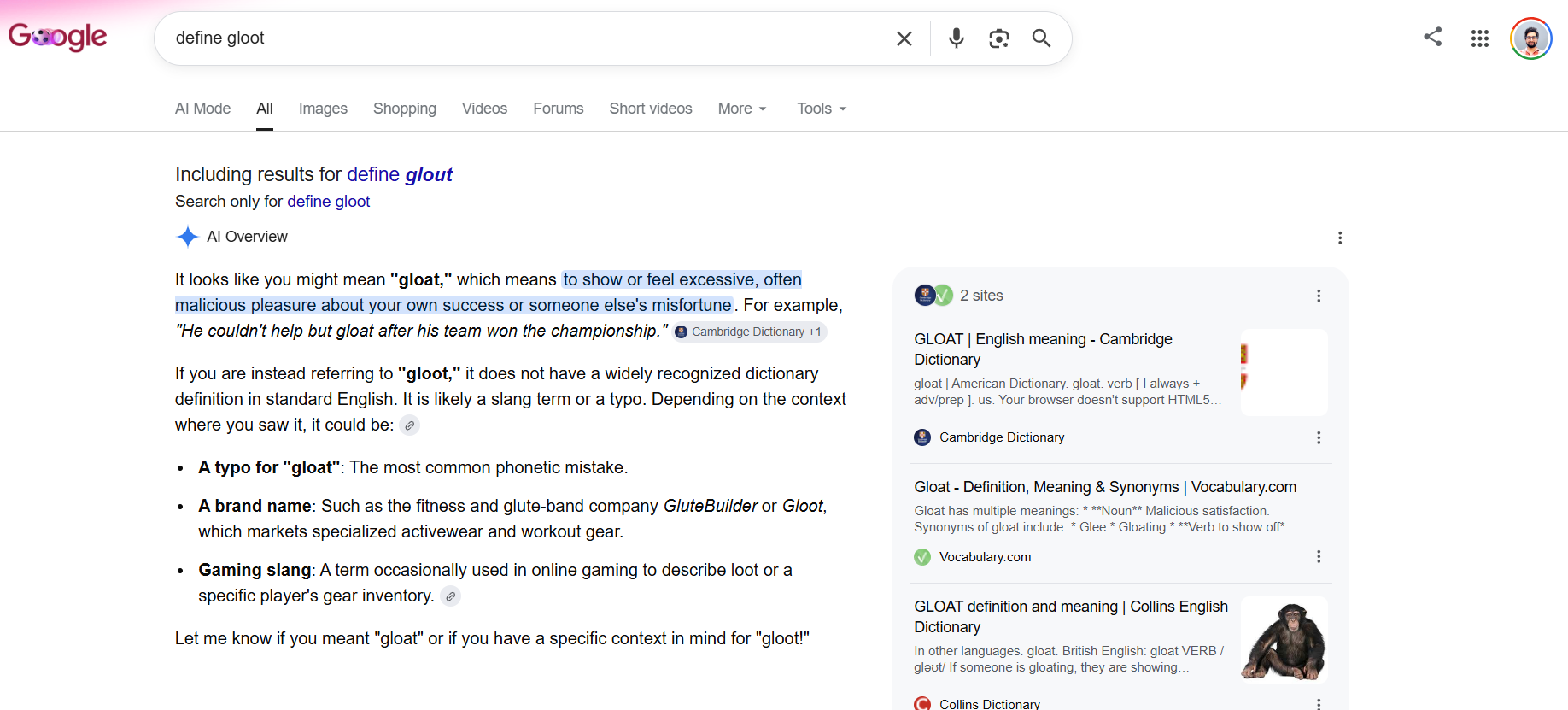
I typed “define gloot” by mistake. Missing the ‘a’.
What Google showed me was more interesting than the word itself. Four distinct engineering decisions, all visible on one search results page.
What happened
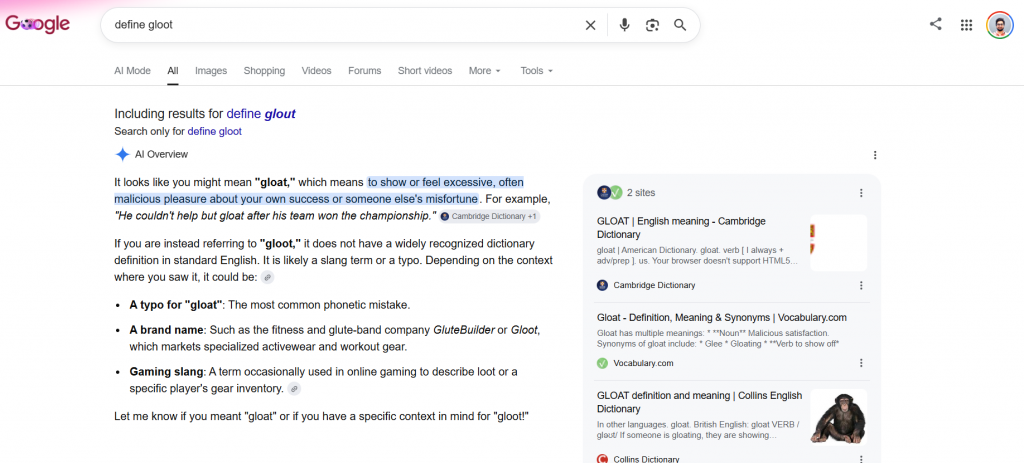
Google’s search index showed: “Including results for define glout”
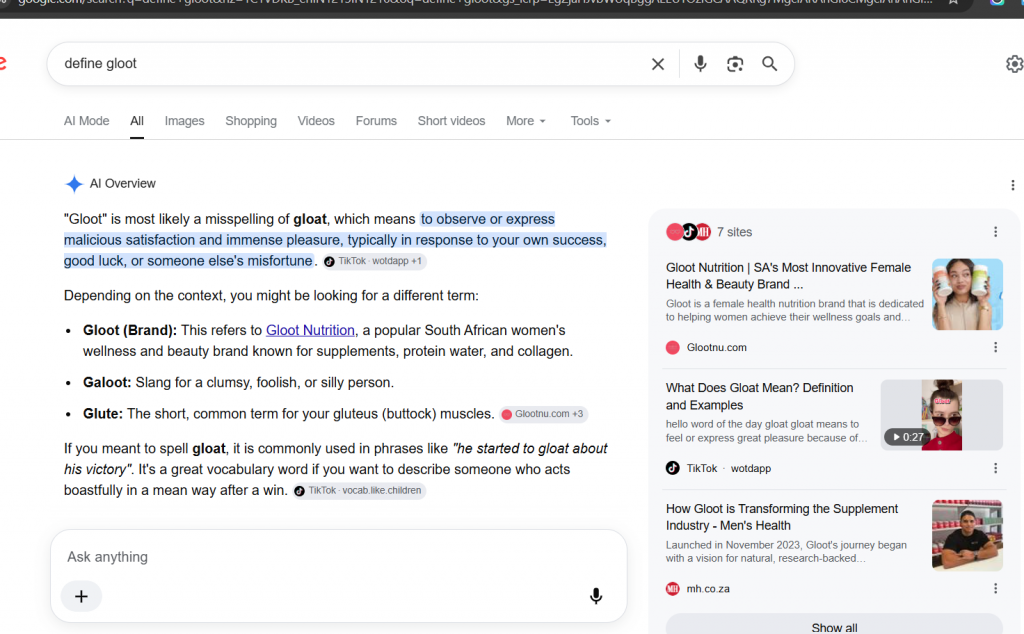
Meanwhile, Google’s own AI Overview on the same page said: “It looks like you might mean gloat.”
Same query. Same page. Two different answers from two different systems.
Then I tested the same query on a US IP. Completely different result – no spelling correction at all.
One typo. Four observations.
Observation 1: The suggestion engine doesn’t use your search history
I was logged into my Google account. Years of search history. I have never searched for “glout” in my life – because it’s not a word I’ve ever needed.
Didn’t matter.
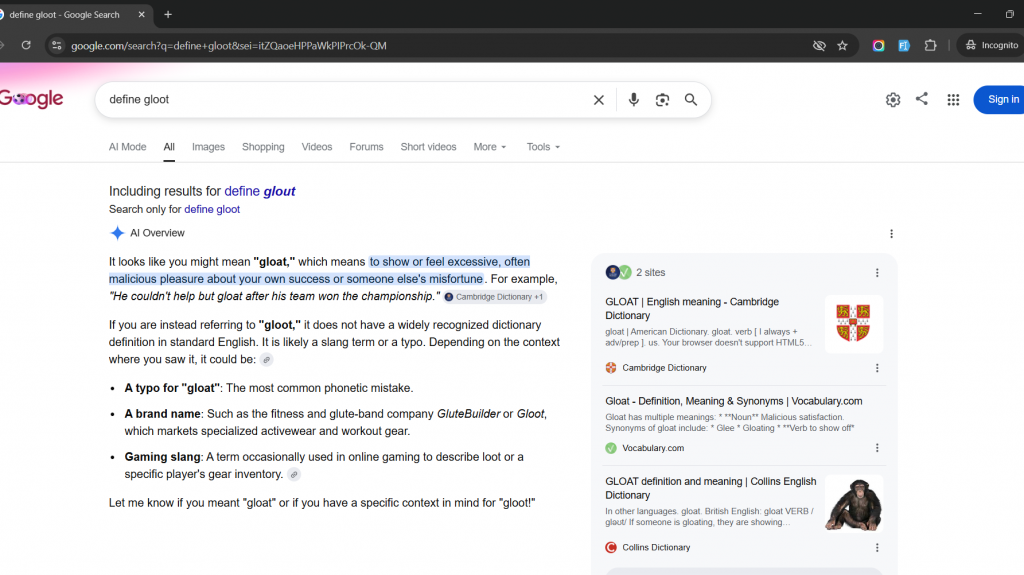
I ran the same query in incognito mode. Identical result. “Including results for define glout.”
This tells you something important about how Google’s spelling correction is architected: it doesn’t personalise. Your individual search history carries zero weight in the correction decision. The engine looks at aggregate signals, what the population searches for, not what you specifically have searched for.
This is probably a deliberate engineering decision. Personalising spelling correction introduces complexity and potential for weird edge cases. If you’ve historically searched for obscure technical terms, should Google assume all your typos are in that domain? Probably not. But the tradeoff is that the correction ignores context it actually has about you.
Observation 2: Edit distance without frequency awareness
The core of most spelling correction systems is edit distance – specifically Levenshtein distance, which measures the minimum number of character insertions, deletions, or substitutions to transform one string into another.
“gloot” → “glout”: substitute the second ‘o’ with ‘u’ = 1 edit
“gloot” → “gloat”: substitute the second ‘o’ with ‘a’ = 1 edit
“gloot” → “galoot”: insert ‘a’ after ‘g’ = 2 edits
Both “glout” and “gloat” are equally close to “gloot” by edit distance. Google picked “glout.”
This is where frequency awareness matters. A well-designed spelling corrector weights candidates by how common the word is in actual usage. “Gloat” is a common English word. “Glout” is not – it barely registers in standard dictionaries.
A system that combines edit distance with word frequency would have ranked “gloat” above “glout” immediately. The fact that Google’s search index didn’t suggests the correction isn’t purely frequency-weighted, or the regional frequency signal for “glout” in India is strong enough to override it.
There’s also keyboard proximity to consider. On a standard QWERTY keyboard, ‘o’ and ‘u’ are adjacent. ‘o’ and ‘a’ are not. Some spelling correction systems weight adjacent-key substitutions as more likely typos. That could explain why “glout” won over “gloat” – the substitution is a more plausible finger slip.
Observation 3: Two systems, one page, no coordination
This is the most interesting observation.
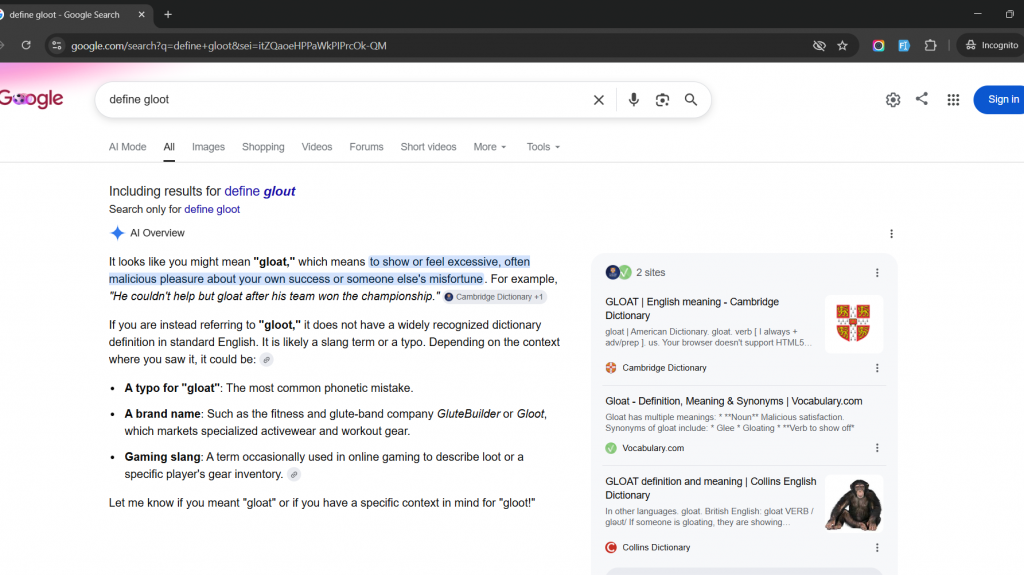
Google’s AI Overview and Google’s search index gave different answers on the same page for the same query.
AI Overview: “It looks like you might mean gloat.”
Search index: “Including results for define glout.”
These are two separate systems with different architectures, different training, and apparently no hard dependency on each other’s output. The AI layer is doing semantic reasoning – it understands that “gloot” is probably a misspelling of “gloat” based on meaning and context. The search index is doing statistical matching – it found enough queries for “glout” in the index to surface it as a correction.
Neither system is wrong on its own terms. But they’re not talking to each other. The result is a page that simultaneously tells you “you probably meant gloat” and shows you results for “glout.”
This is a coordination problem, not a correctness problem. It’s what happens when different teams build different systems that solve adjacent problems without a shared contract between them.
Observation 4: Entity matching changes everything
The US IP result was entirely different. No spelling correction at all.
Why? Because “Gloot” is a real brand – Gloot Nutrition, a South African women’s wellness brand with enough search presence in US/global indices to be recognised as a named entity.
When Google’s entity recognition finds a match, spelling correction is bypassed entirely. The system assumes you might be looking for the brand, serves those results, and lets the AI Overview handle the disambiguation.
In India, that entity signal isn’t strong enough. No entity match means the fallback kicks in, and the fallback is the edit distance model.
This also explains why “galoot” – the word I actually meant, never appeared anywhere. It’s 2 edits away from “gloot.” In a correction system that only considers candidates within 1 edit, galoot is invisible. The algorithm never even evaluated it.
What a better system might look like
A spelling correction system that handled this well would combine:
- Edit distance as the base candidate generator
- Word frequency to rank candidates by how common they actually are
- Phonetic similarity (Soundex, Metaphone) to catch cases where the sound is right but the spelling isn’t, “gloot” sounds like “galoot”
- Semantic context – “define X” strongly implies X is a word, not a brand
- Entity awareness – check entity index before running correction
- Cross-system coordination – if the AI layer and the index disagree, surface that to the user clearly rather than showing both
None of this is novel. Search teams know this. The gap between knowing and shipping is usually organisational complexity, not engineering difficulty.
The word I actually meant never showed up.
Galoot. 2 edits away. Phonetically obvious. Semantically, the only sensible answer given “define” as the prefix.
The algorithm never found it.
One mistyped letter revealed four different engineering tradeoffs on a single page. Search is harder than it looks, and even Google doesn’t always get it right.